
RBI proposed that at least half of the compensation of a CEO should be variable. It also said that stock options should be part of the variable pay, against the extant practice of keeping it beyond and above the scope of the official compensation package.

'We have a plan to plough back a 'This year in the first half we had profits of more than Rs 31,000 crore.' significant amount of profits this financial year.' 'We have seen this organic plough back of profit is one of best ways to support the equity of the bank.'

IDBI Bank had to sell its MF arm after being acquired by state-owned insurance behemoth Life Insurance Corporation since LIC already had an AMC.

RBI wants periodic revision of the pensions for its retired employees.
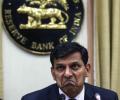
Will RBI chief have the final say, in the form of a veto

Patra, as executive director of the central bank, was the principal advisor to the Monetary Policy Department since July 2012.

The RBI, according to the source, wants details on the procedure followed for credit appraisal by the bank while giving loans to Videocon.

For the past 10 years or more, the RBI has been turning down dozens of applications under the RTI Act that sought disclosing the list of wilful defaulters and the RBI's inspection reports. In fact, it is the only organisation that has a granular and complete view of the heist that has been going on for 25 years at least. But it has escaped any blame for the multiple rounds of bankruptcy and massive periodic recapitalisation of public sector banks caused by bad loans. In fact, they don't want anyone to know how incompetent and collusive they have been in handling bad loans, says Debashis Basu.

The Reserve Bank Officers Cooperative Credit Society, which caters to the credit needs of RBI officers posted all over India, has a fixed deposit of Rs 105 crore in the bank on which the RBI has placed various curbs for six months following revelations of irregularities.

'We expect the bull-market phase to still persist, but now led by large-caps which offer better valuation and benefit from FII inflows.'
'We expect continued pressure on midcaps, but any sharp correction looks unlikely from here on.'

Private sector lender HDFC Bank on Thursday said the Reserve Bank of India (RBI) has asked it temporarily stop all launches of its upcoming digital business-generating activities and sourcing of new credit card customers after outage at its data centre which impacted operations last month.

Since March 2020, when the Nifty50 plummeted to 7,511 following the announcement of a nationwide lockdown, the stock market has been on an upward trajectory. Over the next four years, the major market index has delivered a remarkable compounded annual growth rate (CAGR) of over 31.5 per cent. In the past year alone, the Nifty50 has gained by 27 per cent, hitting a succession of record highs.

The size of the Reserve Bank's balance sheet, which is reflective of activities carried out by it in pursuance of currency issue function as well as monetary policy and reserve management, has increased by 6.99 per cent during the nine-month period ended March 31, 2021. While income for the year decreased by 10.96 per cent, the expenditure decreased by 63.10 per cent, as per the RBI's Annual Report for 2020-21. The year ended with an overall surplus of Rs 99,122 crore as against Rs 57,127.53 crore in the previous year, representing an increase of 73.51 per cent, it added.

The use of RBI capital to strengthen public sector banks will have many positive implications for the economy -- and a few manageable downsides, points out R Jagannathan.
The deadline for officers to decide on their career path in the biggest organisational rejig in the central bank's 85-year history ends on January 31. The immediate fallout could be its disruptive impact on the supervisory process for 2020 -- and beyond -- given the manpower shortfall, even as more entities are set to come under closer central bank scrutiny.

Madhabi Puri Buch, the first female chairperson of Sebi, doesn't plan to rest on her laurels in her third and final year in office and has set out an ambitious goal, such as moving towards a same-day and instantaneous settlement cycle for the secondary market.

'The RBI has not allowed any commercial bank to fail in the past three decades.' 'It has always played the role of a matchmaker, but this is the best deal it has stitched,' notes Tamal Bandyopadhyay.

Patel, 55, who took over as the 24th Governor of the central bank on September 5, 2016, had the shortest tenure since 1992.

Scheduled commercial banks have written off loans amounting to over Rs 10.09 lakh crore in the last five financial years and the process of recovery of dues from the borrowers continues, Union Finance Minister Nirmala Sitharaman informed the Lok Sabha on Monday.

Lenders of debt-ridden Reliance Capital have voted in favour of a resolution plan submitted by Hinduja Group firm IndusInd International Holdings Ltd (IIHL) which made the highest cash offer of Rs 9,661 crore in the second round of bidding. As much as 99 per cent votes were in favour of IIHL as lenders expected to recover cash upfront of Rs 9,661 crore from the Hinduja Group entity, sources said. Besides, sources said cash balance with Reliance Capital (RCAP) of over Rs 500 crore would also go to lenders. So, in all lenders are expected to receive about Rs 10,200 crore for distribution as against Rs 16,000 crore principal secured debt, resulting in 65 per cent recovery for the lenders, sources said.


As deputy governor, Patel headed the RBI panel to draft the monetary policy report, which became the basis of the ongoing reforms at the apex bank

With the government clearing the decks for direct listing at the Gujarat International Finance Tec-City (GIFT City) International Financial Services Centre (IFSC), issuers will wait for the ecosystem to develop further before firming up their listing plans. In the meantime, most companies may continue to prefer listing in the onshore market, even as the new avenue provides key benefits such as tax waivers and reduced foreign exchange risk. Sources said that a few key things need to be ironed out further.

'Those who come from outside are surprised at the relatively small strength of the RBI supervisory cadre, relative to the needs of the country and the needs of the financial sector.'

'We will infuse the next tranche of recapitalisation by mid-December. Close to Rs 42,000 crore remain to be infused as capital in public sector banks in the current financial year,' a senior finance ministry official said.

Governments that did not respect the central bank's independence would sooner or later incur the wrath of financial markets, ignite economic fire, and come to rue the day they undermined the regulatory institution, Deputy Governor Viral Acharya warned.
The central bank said its board of directors had approved the broad contours of the proposals.

How will the RBI announcement on loan moratorium work for those with home loans, auto loans, personal loans, consumer durables loan? Here's what experts have to say.

The contribution from asset management companies (AMCs) has surpassed the Rs 3,000 crore target for the creation of a Rs 33,000 crore backstop facility for debt mutual funds (MFs). The initial corpus for the Corporate Debt Market Development Fund (CDMDF) is nearly Rs 3,100 crore, according to multiple government officials and AMC executives. "The fund is operational now. "The required corpus has been raised by AMCs and the remaining part (Rs 30,000 crore) is in the form of a guarantee from the government which will be activated only in case of a credit event," explained D P Singh, joint CEO and deputy MD, SBI MF.
The International Financial Services Centre Authority (IFSCA) plans to operationalise the framework for direct listing of companies at International Financial Services Centre (IFSC) exchanges by the end of the year, said Chairperson K Rajaraman. He added that the amendments would be notified within three months. Further, the GIFT City regulator is also considering the launch of separate payments system regulations - similar to that of the real time gross settlement (RTGS) for banking within a few months.

The Reserve Bank of India (RBI) announced new rules for credit cards, applicable from July 1. "These directions cover the general and conduct regulations relating to credit, debit and co-branded cards which shall be read along with prudential, payment and technology & cyber security related directions applicable to credit, debit and co-branded cards, as issued by the Reserve Bank," the circular by RBI said. Business Standard culled out key rules from the list, and asked financial experts for advice on them, along with the thumb rules one needs to follow while using credit cards.

'India is not so distant from years of high and entrenched inflationary expectations that it should start trying to play games with the economy the way the West's central bankers think they are entitled to,' argues Mihir S Sharma.

If Sebi and RBI remain quiet about this brazenly illegal activity, will someone in the finance ministry or the NITI Aayog take a closer look, asks Debashis Basu.

'Normally, the system is geared towards counting notes -- it is equipped to do x amount of work and one day you are asking them to do 20 x.' 'The processes involved are very complex.'

Excerpted from Sahara: The Untold Story by Tamal Bandyopadhyay.
An NBFC must actively manage its collateral positions, differentiating between encumbered and unencumbered assets, and monitor such assets so that they can be mobilised in a timely manner, central bank says in circular.

The mutual fund (MF) industry had an action-packed 2023 as it tackled the scrapping of tax benefits for debt fund investors and surging flows into equity funds.
The Reserve Bank of India (RBI) has given HDFC Bank six months to migrate HDFC's home loan customers to external benchmark linked lending rate (EBLR), top sources in the bank told Business Standard. Almost half of HDFC's 5.4 million customers are home loan customers. It is mandatory for banks to link retail loans and loans to micro, medium and small enterprises to an external benchmark. Non-banking financial companies do not have such a mandate.

Reserve Bank Governor Shaktikanta Das on Wednesday said the country is at the doorstep of economic revival on the back of accommodative monetary and fiscal policies being pursued by the central bank and the government.
These changes will entail a relook at the various laws governing banks in the country - the two Bank Nationalisation Acts (passed in 1970 and 1980); the State Bank of India (SBI) Act of 1955; and the Companies Act of 2013.
 © 2026 Rediff.com - Advertise with us - Disclaimer - Privacy Policy - Sitemap - Feedback - About us - Terms of use - Grievances